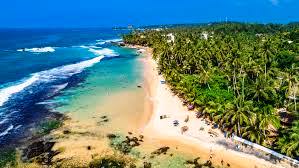
Unawatuna is a lovely beach location on the south coast, Sri Lanka, wonderful for snorkelling and diving as well as relaxation and evening beach parties. Quiet and unique, pleasantly informal compared to it’s neighbour Mirissa where the energetic parties are.
Unawatuna is a known for its beach and corals and only 5 kilometres from the city of Galle with it’s castle walls. Unawatuna is situated at an elevation of 5 metres (16 ft) above the sea level.
Unawatuna Sri lanka 1
Home to the endangered and endemic purple-faced langur, an usually shy monkey species that can only be found in Sri Lanka’s forests, where there is protection afforded by the forest cover to preserve this beautiful creature. There is much eco-tourism being developed by the local community promoting a tourist environment and ecology.
“a seashore dotted with thousands of trees, coconuts, and palms dominating, strings of houses and hermitages along the coastline, human beings and superior beings such as Gandharvas, Siddhas, and ascetics, living in them and countless bejewelled celestial nymphs thronging the shore, the coast intermittently visited by heavenly beings, Gods and demons.” according to historical stories.
Unawatuna traces its roots to the great epic Ramayana. In the epic, the monkey-warrior Hanuman was sent back to India to fetch the four medicinal herbs by Jambavan namely, mritasanjeevani, vishalyakarani, suvarnakarani, and sandhani from the Himalayas in order to heal Lakshman who was wounded trying to save the abducted Princess Sita from the demon king Ravana. Hanuman failed to identify these herbs, so he lifted the entire mountain and carried it to the battlefield to try to save Lakshman, but in the process, a chunk of it “fell-down” in the location of the present day Unawatuna, the name of the village derives from “Una-watuna” meaning “fell down”.
In honour of Hanuman, on the harbour end of Rumassala Hill there is a temple built by Japanese monks of the Mahayana sect of Buddhism named the Peace Pagoda.
Unawatuna is rich in its biodiversity with the greatest potential attraction for eco-tourism was the marsh land or mangrove.
Over sixty species of endemic birds, including terns, egrets, herons, sandpipers and kingfishers, as well as rarer species such as the lesser whistling duck, the Asian palm swift, the white-breasted waterhen, the Loten’s sunbird and the black bittern have been sighted in the locality by the ornithologist, Clive Byers. These birds are mostly sighted in the remaining marshy area and Rumassala Hillock.
Off the coast of Unawatuna, beneath the Indian Ocean lies a number of coral reefs, shipwrecks, and a great variety of fish and turtles. The turtles still wade onto the shore to lay their nests and eggs, and at times, as if to lay first claim to the sandy shore now invaded by the tourists and dotted by restaurateurs, even go right into the beach front restaurants .
The Rumassala coral reefs at the east end of the Galle Harbor attract divers. Eco treks in the shrub jungles of Rumassala are also available.
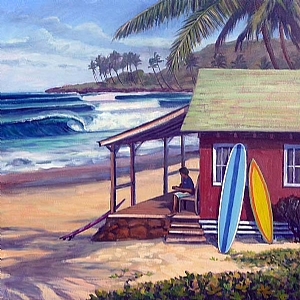
Before asking the question of where to learn, it is important to consider the time of year. Sri Lanka has two surf seasons each lasting about six months: November to April on the South Coast and May to October on the East Coast.
Learning in Peak Season – Is it the Best Choice?
This for many is the obvious choice as the main advantage is that the waves are at their most consistent. However, by learning to surf in Arugam Bay (East Coast) in August or Weligama (South Coast) in January you may not have the experience you were hoping for.
The disadvantages of learning in peak season are numerous:
The need to book the better schools in advance and pay a higher price.
Accommodation is expensive.
The waves are crowded = more risk of injury and a more stressful environment.
If you are confident in the water and do not mind the inherent danger of others also trying to learn in addition to the ones that can surf then go for peak season. On the other hand, if you prefer a more relaxed and safer environment then choose off-season or the months at the start or end of peak season.
South Coast Beginner Surf Locations
A reminder that the surf season on the South Coast is November to April with peak season being December to March.
Weligama Beach – A large bay with a sandy bottom which is extremely popular with beginners and improvers. There are many schools directly on the beach so simply turn up and negotiate!
Galle, Dewata Beach – This spot is quieter than Weligama and ideal for learners as it also has a sandy bottom.
East Coast Beginner Surf Locations
A reminder that the surf season on the East Coast is May to October with peak season being July to September.
Arugam Bay, Baby Point – This spot tends to start working from July until the end of the season. It has a sandy bottom and is ideal for beginners if there are not too many others in the water.
Arugam Bay, Elephant Rock – A very safe point break also with a sandy bottom. There are no schools or facilities here so arrange the lesson before arrival.
Final Advice
There are many other spots along both coasts which can be considered suitable for beginners but the ones mentioned are the most popular. As with all surf spots in Sri Lanka beware of the beach boys who will offer you a cheap/expensive lesson and teach you nothing…
Here are 12 foods you could try whilst in Sri Lanka
For fish ambul thiyal, a large firm fish, such as tuna, is cut into cubes before being sauteed in a blend of spices and dried goraka, a small fruit that gives the dish a sour flavor.
Sri Lanka is famous for making sumptuous use of local fruit, such as coconut and jackfruit, seafood and an utilising a wealth of spices.
Sri Lankan cooking delivers an abundance of incredible dishes.
Fish ambul thiyal (sour fish curry) As you’d expect from an island in the Indian Ocean, seafood plays an important role in Sri Lankan cuisine. Fish ambul thiyal (sour fish curry) is one of the most beloved varieties of the many different fish curries available. The fish — usually something large and firm, such as tuna — is cut into cubes, then sauteed in a blend of spices including black pepper, cinnamon, turmeric, garlic, pandan leaves and curry leaves. Perhaps the most important ingredient is dried goraka, a small fruit responsible for giving the fish a sour flavor. Ambul thiyal is a dry curry dish, meaning all the ingredients are simmered with a small amount of water and cooked until the liquid reduces. This allows the spice mixture to coat each cube of fish. Originating in southern Sri Lanka, it’s available throughout the country at restaurants that serve curry, and is best eaten with rice.
Kottu (also, kottu roti) Over the traffic and noise at a Sri Lankan market, you’ll likely hear the clanking of metal on metal and know kottu isn’t far away. Kottu is Sri Lanka’s hamburger — everybody’s favourite go-to fast food when craving something tasty and greasy. It resembles fried rice, except instead of rice, it’s made with a type of roti known as godamba roti (a flat, crispy bread). The roti is normally fried at the beginning of the day, piled into stacks and served as it’s ordered. When you place an order, the kottu chef will fry and chop the roti with a selection of ingredients you choose. The result is a tasty mixture of salty pieces of fried dough, lightly spiced and extremely comforting. Kottu is served with spicy curry sauce, which you can either use as a dip or pour over your entire plate. Some of the most skilled kottu chefs compose their own unique songs, singing while they rhythmically clank their spatula and knives against the metal frying surface, slicing the roti with each clank.
Kukul mas curry (chicken curry) Simple to make, chicken curry is a common household dish in Sri Lanka. There are many variations depending on region and taste preferences. Spices like fennel seeds, cardamom, cloves and cinnamon sticks are tempered in hot oil before being combined with chicken and spices like chilli powder, curry powder, turmeric, pandan leaves, lemongrass and curry leaves. Coconut milk contributes to the rich base of the curry gravy. Depending on the recipe, a puree of tomato is often included. The chicken is stewed for an hour or so until the essence of the spices is infused into the chicken. Most satisfying when served with hot rice and roti.
Parippu (dhal curry) Parippu, or dhal curry, is the most common curry in all of Sri Lankan cuisine, a staple in any restaurant or household. Masoor dhal (split red lentils) are first rinsed and boiled until soft. In a separate pan, a number of fresh ingredients, such as onions, tomatoes and fresh green chillies, are sauteed and mixed with tempered spices like cumin seeds, turmeric, fenugreek, mustard seeds and curry leaves. All the ingredients are combined and usually thickened with a splash of fresh coconut milk to give the dhal a rich flavor and creamy texture. It goes with everything, but is perfect as a dipping gravy for a fresh roti or paratha.
Lamprais Sri Lanka has been influenced by a diversity of cultures and one of the most evident is the Dutch Burgher community. Lamprais, a word that combines the two Dutch words for “lump” and “rice,” is a combination of meat, rice and sambol chilli sauce, wrapped into a banana leaf packet and steamed. The rice is cooked with meat stock — usually a combination of different meats like beef, pork or lamb — that’s infused with cardamom, clove and cinnamon. A scoop of rice is placed in the centre of a banana leaf, along with the mixed meat curry, two frikkadels (Dutch-style beef balls), blachan (a shrimp paste) and a starch or vegetable, usually either ash plantain or brinjals. The package is folded into a parcel and steamed. Since lamprais is a Burgher contribution to Sri Lankan cuisine, the meat is usually prepared with sweet spices like clove and cinnamon, recreating the flavor favoured by the Dutch Burgher community. Original recipes called for beef, pork and lamb, but chicken and eggs are often included in a modern lamprais packet.
Hoppers (appa or appam) Also, string hoppers (indi appa or idiyappam) Hoppers are the Sri Lankan answer to the pancake. The batter is made from a slightly fermented concoction of rice flour, coconut milk, sometimes coconut water and a hint of sugar. A ladle of batter is fried in a small wok and swirled around to even it out. Hoppers can be sweet or savoury, but one of the local favourites is egg hoppers. An egg is cracked into the bowl-shaped pancake, creating the Sri Lankan version of an “egg in the hole.” Egg hoppers are garnished with lunu miris, a sambol of onions, chillies, lemon juice and salt. Unlike the runny batter used for hoppers, string hoppers are made from a much thicker dough. The dough is squeezed through a string hopper maker, like a pasta press, to create thin strands of noodles, which are steamed. String hoppers are normally eaten for breakfast or dinner with curries.
Polos (green jackfruit curry) Jackfruit is consumed in a number of different stages of ripeness, from very ripe and sweet to green and starchy. Polos is a Sri Lankan curry prepared with young green jackfruit. The fruit is sliced into bite-sized chunks and boiled until soft. It’s then cooked with onions, garlic, ginger and spices like mustard seeds, turmeric, chilli powder, roasted curry powder, pandan leaves and curry leaf sprigs. The final step is to add coconut milk and simmer to reduce most of the liquid, leaving all the beautiful flavors within the cubes of jackfruit. Jackfruit has a starchy texture, somewhat similar to cassava or potato. Polos is a standard dish available at most Sri Lankan curry restaurants.
Wambatu moju (eggplant/brinjals pickle) Served mostly with rice and curries, wambatu moju is an extremely flavorful candied eggplant (brinjals) pickle. The eggplant — usually the purple-skinned, long and slender variety — is cut into bite-sized wedges and deep fried, giving the eggplant a crispy texture with a soft and silky interior. It’s then caramelised with a spoon of sugar, vinegar, red onions, green chillies, mustard seeds, chilli powder and a hint of turmeric powder until the colour turns almost black. Take a bite and the soft and juicy texture of the eggplant should melt in your mouth — the slightly sweet, sour and salty contrast is absolutely sensational.
Gotu kola sambol (pennywort salad) One of the most readily available green vegetable dishes in Sri Lanka is gotu kola sambol. Gotu kola (known in English as Asiatic pennywort) is a medicinal herb in Asia. It’s shredded into slivers, then combined with shallots, tomatoes, fresh grated coconut and chilli and seasoned with a dressing of salt, pepper and lemon juice. Sambol is a term used in Sri Lanka for ingredients that are combined and eaten raw, sometimes more of a chili sauce and sometimes more of a salad, like gotu kola sambol. Gotu kola has a powerful, herbaceous flavor similar to kale, making it an extremely fresh and crisp dish. It’s typically a side dish served with curry and rice.
Kiribath with lunu miris (Milk Rice) Kiribath is a special type of rice, cooked with thick coconut milk and often served during special or auspicious occasions, such as Sinhalese New Year. There are a few versions of kiribath, but the basic procedure is to start by boiling a pot of rice. Before the rice finishes cooking, add coconut milk and a pinch of salt. The coconut milk makes the rice creamy and rich and helps it form a sticky consistency. Once the rice is finished cooking, it’s cut into wedges and served like slices of cake. Kiribath can be eaten along with a number of different Sri Lankan dishes, often either sweetened or consumed salty with chili sauce or curry. One of the most common ways to garnish kiribath is with lunu miris, a sambol chilli sauce made from red chillies, onions, lemon juice, salt and sometimes dry Maldive fish, all ground into a paste using a stone mortar and pestle.
Pol Sambol (coconut relish) In a country in which the coconut is of supreme importance, there’s one Sri Lankan side dish that pays fitting tribute. Pol sambol, which might also be called fresh coconut relish, is a simple blend of finely grated coconut, red onions, dried whole chillies or chilli powder, lime juice, salt and Maldive fish (if available). The ingredients are diced or ground, then combined in a bowl. In Sri Lanka, pol sambol is used as a garnish or side dish for everything and anything. It goes well with rice and curry, pol roti (coconut roti), a hot paratha, string hoppers or even just scooped up with slices of bread. If you love coconut, there’s no better garnish in the world. Sri Lanka’s top tea experiences: Sips of history
Wood apple It wouldn’t be a Sri Lankan food discussion without wood apple. The wood apple is a Southeast Asian fruit about the size of a de-husked coconut. It also has just as hard of a shell, and a pungent, almost blue cheese aroma. Walking through a market in Sri Lanka your nose will detect it long before your eyes do. Inside the shell is a dark brown paste that resembles something between tamarind pulp and fermented raisins. Wood apple can be eaten directly out of the shell, but one of the most popular ways to eat (or drink) it throughout Sri Lanka is in a thick smoothie, known as wood apple juice. The fruit is blended with sugar and water to smooth it out. It has a unique sour and sweet flavor. Mention that you love wood apple to any Sri Lankan you meet, and they probably won’t be able to hold back a knowing smile.
Kudawella is a small coastal town near Tangalle on the South East coast of Sri Lanka.
There are some good guest houses localy and bigger hotels in nearby Tangalle.
You can find some beautiful beaches and walks through the coastal jungle.
Landmarks
Hummanaya Blow Hole
Wewurukannala Vihara Temple
Dickwella Beach
Tangalle Lighthouse
Parewella Natural Swimming Area
Rekawa Turtle Conservation Project
Dondra Lighthouse
Hummanaya is a natural blowhole, and caused when sea water rushes through a submerged cavern and is pushed upwards. The sea water flows underneath the shore, and then comes out of this hole due to pressure. The water fountain created by the geological feature shoots up every couple of minutes, depending on the nature of the sea, with the spray often reaching as high as 25 m (82 ft) to 30 m (98 ft).
Hummanaya Blowhole is the only known blowhole in Sri Lanka and it is considered to be the second largest blowhole in the world. “Hummanaya” (Sinhala: හුම්මානය = හූ+මානය) refers to the noise, “hoo”, that can be heard a distance away when the blowhole is active.
This site has now been developed as a tourist attraction, with a small visitors’ information centre on marine life and a viewing platform
The Hummanaya Blowhole is located 1.1 kilometres (0.7 mi) from the small fishing village of Kudawella, which is 28 km (17 mi) from Matara, 5 km (3.1 mi) from Dikwella and 12 km (7.5 mi) from Tangalle, in the Southern Province.
PADI Open Water scuba dive certification – Poseidon Dive Station Hikkaduwa Sri Lanka
After years of awe at the magnificence that is the beautiful ocean, coupled with a fear of what might be lurking in there preventing me from jumping in and enjoying the great pool, I finally lady-sacked up and completed my PADI Open Water scuba dive certification.
Yup. Jess Hooper donned a mask and air tank, rolled backward off of a boat into the Indian Ocean and explored. Who is this person?! I like her better than the scared version of Hoop (Jess) who would hold her best friends hand, dip in a toe and run away as if there was a shark waiting right there at the end of her leg.
PADI Open Water scuba dive certification – Poseidon Dive Station Hikkaduwa Sri Lanka
The confined dive in the shallows of Hikkaduwa Beach got me excited and hungry for a deeper dive. Breathing under water is so strange but so beautiful and had me chuckling to myself as I felt like a cross between a very awkward little mermaid and Darth Vader combined. The following day, I finally got into deeper water and boy, did I suck at diving.
Dive #1. “You kick your legs sort of like you’re riding a bike”. Well shit. I have a couple of friends who will love this as me on a bike of any kind is a logistical fail of epic proportions. “It’s okay, we can work on it, it will get better”.
The instructor Erin was a legend and just what I needed, the perfect combination of professional and calmingly casual. I couldn’t have asked for a better leader when it comes to learning how to literally jump out of my comfort zone and into the deep end. I semi-lost my buddy Nimantha but later found out he was holding my tank and guiding me along because the frog legs were getting me nowhere. Try, try and try again right?
Dive #2 was ever so slightly more successful and I almost had the leg coordination and not freaking out that I’m under water down. New mountain to climb…don’t over inflate your Buoyancy Control Device and float towards the surface like a derp. Grace never was my forte.
Dives #3 and 4 were so much better and I think (am almost sure anyway) that I had the legs, buoyancy and calm down. I loved it! It really is a whole other world down there, an indescribable world of peace, quiet, marine life, beautiful rock formations and conquered fears. I faced another scaredy too and jumped off the boat and swam on the surface. I won’t lie and say I was ready and willing, I had to pee and in the ocean is much better than in a wet-suit on a boat in fear of somebody seeing me pee in the ocean. After that first one, swimming became glorious, truly glorious and free compared to wearing the weight of equipment.
Being asked to get back in the boat so we could set off filled me with pride that not only was I in there bobbing around, I was enjoying myself.
I can’t wait to get back out there and explore more of the sea bed, Walt Disney’s’ “Under The Sea” rolling around in my head and am so grateful to be in picturesque Sri Lanka to keep practicing and experience more.
To the Poseidon Dive Station team, you’re the tits*. Truly great at what you do, awesome humans, professional and the best people to have started this underwater journey with. Thank you and I’ll forever have a place in my heart for the people who made me feel at ease in natures wonder – and on a high powered speed boat ?
*This has caused confusion before so to clarify; just as breasts are beautiful, functional, great fun and lovely overall, people who are ‘the tits’ are all of the above and more.
Dates of Islamic holidays are subject to change in accordance with the moon sighting
January 1 – New Year’s Day
New Year’s Day is fixed on January 1 to celebrate the dawn of the new Gregorian year. The UAE joins the global party with fireworks, parades, and parties. Every year, the Burj Khalifa is the centerpiece for one of the greatest firework displays in the world.
In 2018, New Year’s Day falls on a Monday, so it won’t be a long weekend unless you book the 31st of December off. Plan well in advance.
April 13 – Al Isra’a Wal Mi’raj – Ascension Day
Al Isra’a Wal Mi’raj is an Islamic holiday, which is observed annually on the 27th day of the Islamic month of Rajab, according to the Hijri calendar. The holiday marks the night Allah took Mohammad (PBUH) on a journey from Makkah to Jerusalem, and then to heaven. The journey was made in a single night, hence the name.
In 2018 the holiday falls on Friday, April 13.
June 15 – Eid Al Fitr
Roughly translated, Eid Al Fitr means “festival of breaking the fast”. The holiday is a celebration which marks the end of Ramadan (which is forecast to end on June 15 or 16). It is a time to show kindness to others and love for Allah.
Eid Al Fitr begins automatically after the last day of Ramadan, on the first day of Shawwal. Holidays vary between one or two days from the start of Eid Al Fitr.
June 15 and 16 fall on a Friday and Saturday respectively.
August 21 – Arafat Day
Arafat Day is the second day of the annual haj (or pilgrimage). The holiday takes place the day before the start of Eid Al Adha. At dawn, Muslim pilgrims make their way from Mina to a nearby hillside called Mount Arafat and a plain called the Plain of Arafat.
In 2018 Arafat Day falls on a Tuesday.
The date is subject to moon-sighting and could change.
August 22 – Eid Al Adha
Eid Al Adha translates to the “festival of sacrifice”. The holiday honours Ibrahim and his willingness to sacrifice his son Ismail for Allah. Ismail is happy to oblige before Allah sends his angel, Jibra’il, to inform Ibrahim that he has already accepted the sacrifice from his heart.
Goats are sacrificed and divided into three parts: one part for the family, one part for relatives, and one part for the poor. The holiday begins on the 10th day of Dhu Al Hijja – the last month of the Hijri calendar.
In 2018, Eid Al Adha is expected to begin on Wednesday, August 22. A two day holiday for Eid Al Adha, including a one-day holiday for Arafat Day on Tuesday, ensures a (very) long weekend in August.
September 11 – Al Hijri – Islamic New Year
Al Hijri is the Islamic New Year. Expected to fall on Tuesday, September 11 in 2018.
The date is subject to moon-sighting and could change.
November 20 – Prophet Mohammad’s (PBUH) Birthday
The birthday of Prophet Mohammad (PBUH) is celebrated on the 12th day of Rabi Al Awwal. In Arabic, the holiday is referred to as Eid Al Mawlid an Nabawi.
In 2018, November 20 falls on a Tuesday.
The date is subject to moon-sighting and could change.
November 30 – Commemoration Day
Commemoration Day (sometimes referred to as Martyr’s Day) is a public holiday on November 30. The day was declared by His Highness Shaikh Khalifa Bin Zayed Al Nahyan, President of the UAE, in 2015 to honour Emiratis who have died for their country.
The remembrance will fall on a Friday in 2018.
December 2 – UAE National Day
The UAE’s National Day is fixed on December 2 each year. Although the UAE – or the Trucial States as it was known until 1971 – was never part of the British Empire, it was a British Protectorate. The protectorate treaty was withdrawn on December 1 1971, paving the way for the federal unification of the Trucial States.
Abu Dhabi, Dubai, Sharjah, Ajman, Umm Al Quwain, and Fujairah made up the original UAE, with Ras Al Khaimah joining in a year later in 1972. 2018 will be the UAE’s 47th birthday.
One or two days are granted as public holidays, and as December 2 is a Sunday, we could enjoy a long weekend.
Sri Lanka is an awesome tropical island with steady temperatures generally remaining between 25°C and 35°C.
There are windy and rainy seasons one side of the island, whilst the other side tends to be less windy and drier.
You can choose your dates for the side of the island that you want to explore, alternatively, if you have fixed dates, choose the side of the island that has your desired weather.
Here are some top tips to enjoy your visit.
Seek our advice – it’s free
Select one of our preferred tour guides – you will see more for less!
Let us take the strain – we can supply a good driver to collect you at the airport – no stress after your flight
Be realistic in what you want to see in your time frame – there is o much to see on one beautifully diverse tropical island.
Get the right accommodation for your needs – AC is desirable in some months and not needed in others.
Travel light to enjoy the freedom of the island – or – we can escort you and your travel baggage at arm’s length.
Sample the local foods – not all are super spicy!
Bring a good camera and/or smartphone – but don’t flaunt it – be discrete
Do some research (through our websites) and select what you want to see/experience.
Discover the cultural beliefs and ceremonies which are as diverse as the scenery on this lovely island.