Blog

  • Good Dive Centers Sri Lanka

    Good Dive Centers Sri Lanka

    There are some great places to learn to dive in Sri Lanka

    Sri Lanka is a BEAUTIFUL TROPICAL ISLAND.  Which means you can dive almost every where!

    Sri Lanka – the beautiful tropical island conveniently situated near the airline hubs of the world. Just over four hours from Dubai and Abu Dhabi.

    The beautiful paradise island with hundreds of fabulous dive sites. Come dive the dozens of famous ship wrecks dating back to the colonial era and also visit coral reefs, under sea caves & rock formations all around our island.

    SRI LANKA DIVE PADI

    GOOD DIVE SCHOOLS in SRI LANKA

    There are some well reputed dive centers offer certifications up to Instructor. The Open Water, Advanced and Rescue Diver courses may take about 3 to 4 days each

    Blue Deep Diving Centre

    Blue Deep Dive

    International Dive School – Hikkduwa & Trinco

    international dive school


    Poseiden Dive Centre – Hikkaduwa & Trinco
    Poseidon Dive


    Here are just some of the popular areas for diving.

    Kalpitiya – Rocky/Coral Reefs including the Bar Reef Marine Sanctuary (Snorkel)
    Negombo – Rocky/Coral Reefs and great marine life
    Colombo – Rocky/Coral Reefs and Ship Wrecks (Best wreck diving in the island)
    Beruwala -Deep rocky outcrops and Coral
    Bentota – Rocky outcrops and Coral
    Hikkaduwa – Rocky outcrops, Coral Reefs and Ship Wrecks. Can Snorkel in Lagoon
    Unawatuna,- Rocky reefs and Ship Wrecks
    Weligama, Shallow Rocky/Coral Reefs
    Tangalla – Not explored and documented by us yet.
    Basses – Fantastic limestone reef with ship wrecks and amazing fish life
    Trincomalee – Rocky/Coral Reefs
    Batticaloa – Rocky/Coral Reefs and shallow & deep Ship Wrecks

    The good news is that because we have two main seasons each side of the island has a “Best to dive” season.

    West Coast Season is November-April

    East Coast Season is May-October

    Diving in Hikkaduwa

    Site Depth Boat Travel Information
    The Conch 20M 45 Min A great dive for wreck enthusiasts
    Kiralagala 39.4M 25 Min On the edge of the recreational diving limit… a beautiful rock complex raining with fish!

    This dive is accessible only for divers with PADI Advanced Open Water certification or PADI Deep Diver specialty course experience.

    Deep Rock (Diyamba Gala) 22M 20 Min A multilevel rock complex with lots of underground caves.

    Proceed with caution into the caves as entrapment is a possibility on the low overhanging.

    For experienced divers only.

    Earl of Shaftesbury 12-14M 35 Min An old British iron sail ship.

    A real wreck withsome components still recognizable and a fun dive experience on a sandy bottom.

    Off Coral Gardens 13M 10 Min Very close to the Coral Gardens hotel. Can observe varied fauna from little Moray Eels, Pufferfish, Porcupinefish, Sea Slugs and the usual suspects.

    A few underground caves and valleys which are awesome.

    Special mention is the beautiful coral. Mostly red and orange. There is this one rock full of beautiful coral.

    Black Coral Point 30M 10M A deeper dive site closer to the shore.

    Covered with beautiful black coral and quite abundant with small creatures for the macro enthusiast.

    Goda Gala 22M 20 Min A multi level rock complex with interesting places harbouring various kinds of fish life including Honeycomb Moray Eels.
    Sunil Gala 18M 20 Min A dive site south of the Coral Garden rock formation and closer to shore than Goda Gala.

    A multi-level rock complex sometimes subject to wave surge because of the proximity to shore.

    Tunatta 13M 15 Min Situated south of Coral Gardens rock formation, this is a very shallow dive site and because its closer to the shore subjected to some surge.

    The rock formation in itself is very interesting and there are some swim through’s.

    Lobsters, Pufferfish, Boxfish, Porcupinefish can be found here.

  • Kataragama

    The pilgrimage town of Kataragama is situated in the south of Sri Lanka.

    Kataragama is unique as it is a religious site visited by Buddhists, Hindus, Muslims. Christians are also welcome.

    Historically Kataragama was a shrine area deep in the jungle of down south sri lanka and very difficult to access. However today it is easily accessible by an all-weather road. The shrines and the nearby Kiri Vehera are managed by Buddhists, the shrines dedicated to Teyvāṉai and Shiva are managed by Hindus and the mosque by Muslims.

    There are many guest houses for pilgrims and visitors to stay. There are small restaurants and shopping available.

    The town has the Ruhunu Maha Kataragama devalaya, a shrine dedicated to Skanda-Murukan also known as Kataragamadevio. Kataragama is in the Monaragala District of Uva province, Sri Lanka.

    Kataragama is situated some 230 km ESE of Colombo, the capital of Sri Lanka. Although Kataragama was a small village in medieval times, today it is a developing area encircled by lush jungle with beautiful wildlife flowers and trees.

    Kataragama houses the ancient Kiri Vehera Buddhist stupa. The town has a venerable history dating back to the first century. It was the seat of government of many Sinhalese kings during the days of Rohana kingdom.

    Kataragama is sacred to all, Buddhist, Hindu, Muslim and the indigenous Vedda “Jungle” people of Sri Lanka.

    Kataragama temple complex dates back to the 1st century and has a number of ancient inscriptions and ruins since that time. Kiri Vehera is believed to have been built or renovated around the 1st century BCE. There is an inscription, a votive offering to the Mangala Mahacetiya, the former name of Kiri Vehera on the orders of the son of king Tiritara who ruled in 447 CE.

    The medieval phase of the history of the shrine began with the arrival of Kalyanagiri Swamy from North India sometimes during the 16th or 17th century. He identified the very spot of the shrines and their mythic associations with characters and events as expounded in Kanda Puranam. Following the re-establishment of the forest shrine, it again became a place of pilgrimage for Indian and Sri Lankan Hindus. The shrine also attracted local Sinhala Buddhist devotees. The caretakers of the shrines were people of the forest who were of indigenous Vedda or mixed Vedda and Sinhalese lineages. The shrines popularity increased with the veneration of the place by the kings of the Kingdom of Kandy, the last indigenous kingdom before colonial occupation of the island.

    Muslims refer to Kataragama as “al-Khidr” or land of Khidr. A number of Muslim holy men migrated from India and settled down in the vicinity. The earliest known is Hayathu, whose simple residence became the first mosque in Kataragama. Karima Nabi is said to have discovered a source of water that when drunk provides immortality.

    The shrine of Maha Devale or Maha Kovil is dedicated to Skanda-Murugan known amongst the Sinhalese as Kataragama deviyo. It holds a Yantra, a spiritual drawing of the deity’s power. Of all the shrines in the complex, it is the largest and the first that all pilgrims come to visit. Although it does not have a representation of the deity, kept in an adjoining room is a statue of Shiva also known amongst Sinhalese as Karanduva. Within is a clay arm chair known as Kalana Mandima that supposedly belonged to Kalyanagiri Swamy. It is covered by a leopard’s skin and on it has all the ceremonial instruments.

    To the left of the main shrine lies a smaller shrine dedicated to the Hindu god Ganesha who is known as Ganapatidevio amongst Sinhalese. Tamils refer to him as the Manica Pillaiyar. It is a small rectangular building without any decoration. To the left of Ganesha shrine stands the Vishnu Devale the shrine dedicated to Vishnu within which there is also a Buddha image. Behind this is a large Bo tree that tradition believes is from a sapling of the original Bo tree in Anuradhapura.

    Attached to the western wall of the shrine complex are shrines dedicated Kali, Pattini, Managara devio, Dedimunda and Suniyam.

    Outside the temple yard and beyond the northern gate lies the shrine to Teyvanai, the consort of Murugan. Teyvanai shrine is managed by the Sankara Mutt from Sringeri in Karnataka, India.

    A shrine dedicated to Valli, the consort of the main deity lies in front of the mosque.

    Close to the Valli shrine is a Kadamba tree that is sacred to Murugan.

    Within the mosque are number of tombs of Muslim holy men.

    There is also a separate shrine dedicated to the tomb of Kalayangiri swamy known amongst Tamils as Mutuligaswamy kovil. It is also known as the Siva Devale.

    Katargamadevio cult legends in Sri Lanka claim that Valli was a daughter of a Vedda chief from Kataragama in the south of the island. The town of Kalutara, known in some sources as Velapura, became associated with Murukan worship also. The cult of Murukan was grafted onto the worship of Skanda-Kumara that was prevalent in Sri Lanka. Amongst the Sinhalese he became known as the god of Kataragama village, thus Kataragamdevio. Shrines of Katargamadevio are found in almost all Sinhala Buddhist villages and towns. He is recognized as one of the guardian deities.

    Worshipers take an arduous pilgrimage on foot through jungles to fulfill their vows to the deity. The pilgrimage includes Tamils from India and Sri Lanka as well as Sinhalese.

    Some temples in the east coast of Sri Lanka became identified with Kataragama temple and synchronized their festivals based on the arrival of pilgrims all the way from the north of the island. These include temples in Verugal, Mandur, Tirukovil and Okanda. In the interior of the island temples such as Embekke were built in the 15 to 17 the century CE to propitiate the Murukan aspect of Kataragamdevio by the Sinhalese elite.

    Since the 1950s the cult of Kataragama has taken a nationalistic tone amongst the Sinhalese people. People visit the shrine year long, and during the annual festival it takes on the appearance of a carnival. People get into trance and indulge in ecstatic rituals formerly associated with Hindus such as fire walking, Kavadi and even body piercing or hook swinging.[16] These ecstatic rituals have carried through the island and are widely practiced.

    Kataragama festivals and daily rituals do not adhere to standard Hindu Agamic or Buddhist rituals. Ancient Vedda traditions of worship. Since the medieval period Hindus, Buddhists and even Muslims have co-opted the temple, deity and its worship, the various rituals maintained by the native priests are still performed.

    The main festival known in Sinhalese as Esela Perehera. It is celebrated during the months of July and August. About 45 days before the festival begins, the priests go into the forest and find two forked branches of a sacred tree. The branches are then immersed in the local river and kept at the shrines dedicated to Kataragama deviyo and Vali. When the main festival begins, the Yantra representing the deity is retrieved from its storage location, paraded through a street on top of an elephant, and carried to the Valli shrine. After two hours it is returned. On the last day of the festival the Yantra is left overnight at the Valli shrine and brought back to the main shrine. The priests conduct the rituals in silence, covering their mouths with white cloth. Associated with the main festival is fire walking arranged by a master of the ritual. Hundreds of devotees participate in fire walking, yet others participate in ecstatic dance forms called Kavadi and body piercing.


  • Weather trends on the south west coast of Sri Lanka

    Weather trends on the south west coast of Sri Lanka


    Weather trends on the south west coast of Sri Lanka

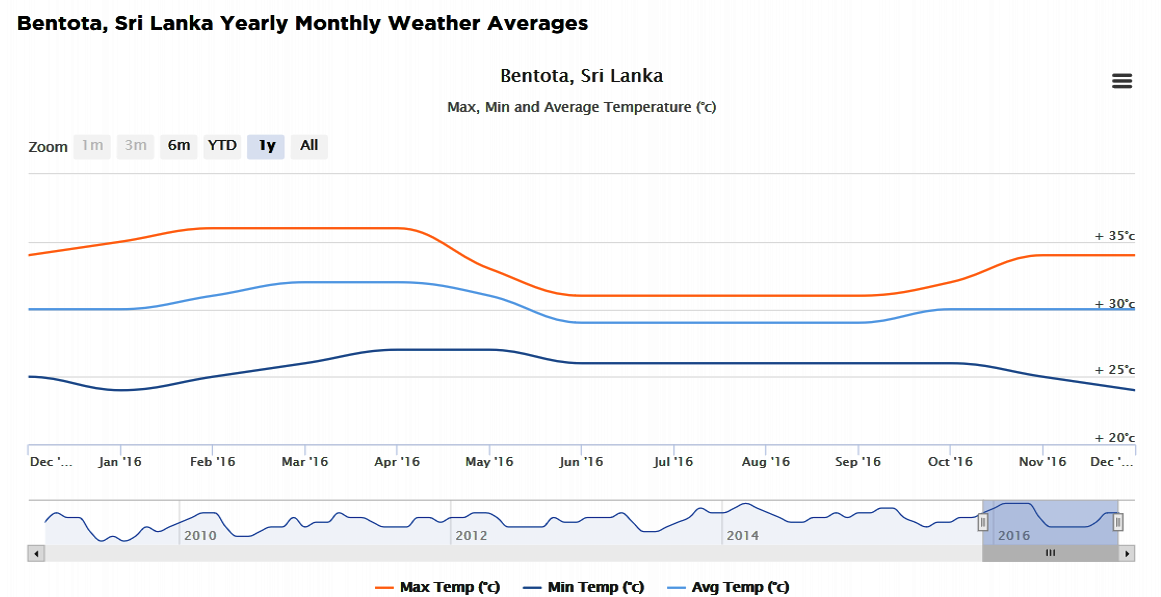
    Weather trends on the south west coast of Sri Lanka has a tropical climate governed by monsoon winds. It is warm, around 30°C in the day, and can be humid in between heavy rain showers. Rainfall is generally quite high with two distinct peak rainy seasons.

    Southwest Monsoon Season: May – Mid October

    Bentota’s location within the southwest coast put it first in the path of the monsoon winds as they first arrive bringing fresh sea winds to Sri Lanka.

    These winds originate in Africa and pick up moisture as they travel on their ocean passage of the Indian Ocean.

    Rainfall peaks at the beginning and end of the season when almost 400mm can fall in a month.

    Rain usually falls in brief but heavy storms breaking the tropical sunshine.

    Flash flooding may occur on some low lands but not the higher grounds. The storms are usually strongest in May when humidity is also at its highest for the year.

    There is a lull in rainfall in July and August. Rainfall during these months is less frequent however it can come in heavy rain showers.

    Temperatures fall slightly throughout the season, starting at an average high of 30°C in May and working down to 28°C in October. Night time temperatures fall from the mid to the low 20s but high humidity means this can still be uncomfortable at times outside.

    Throughout the period a daily average of six hours of sunshine can be enjoyed per day as clouds often linger in the sky until they give up their rain to the lush forest areas.

    The sea temperature drops pleasantly in July and September to delightful 27°C.

    First Inter-Monsoon Season: Early October

    The monsoon rains recede but are noticeable in the rivers of Bentota and its surrounding regions. Rainfall levels feeding the rivers remain high. Squalls, sudden, strong wind may be experienced.

    Northeast Monsoon Season: November– March

    As the monsoon winds are from the northeast keeps Bentota and “Down South” dry with calmer seas, which make this ideal for surfing and watersports..

    There are clear skies and extra hours of sunshine each day making this an ideal destination to enjoy the outdoors.

    The average high temperature maintains a mid day high of around 31°C from February till March.

    Lower humidity gives this tropical island a delightfully pleasant climate for the “Down South” season.

    December, January and February are really the best months to visit “Down South Sri Lanka”. Bentota and south west coast – enjoying both low rainfall and reliable sunshine.

    Second Inter-Monsoon Season: April– May

    As the southwest monsoon winds begin to return, rainfall starts to increase, usually falling in evening thunderstorms with some spectacular thunder storms visible out at sea.

    While rain is the dominant feature of the weather, the brevity of these storms means that a great deal of sunshine is to be enjoyed.

    Outside of the peak rainfall months, rain comes as a pleasant relief providing a seaside tranquility for flowers and trees.

    Visiting this exquisite tropical island that is Sri Lanka, revitalize your soul, with some wearher acclimatisation helpful but not necessary.

    Some humid days are a small price to pay for the exotic landscape and contrast in culture when compared other climatically challenged destinations.

    So, pack your folding brolly and enjoy all that Sri Lanka has to offer.

  • Hilton Hotels = Kandy + Yala + Kosgoda + Nuwara-Eliya + Colombo + Negombo

    Hilton Hotels = Kandy + Yala + Kosgoda + Nuwara-Eliya + Colombo + Negombo

    Hilton = Kandy + Yala + Kosgoda + Nuwara-Eliya + Colombo + Negombo

    • Hilton Kandy Resort will have 150 rooms
    • Hilton Yala Resort & Spa will have 42 rooms
    • Hilton Kosgoda Resort will have 200 rooms
    • DoubleTree by Hilton Nuwara Eliya will have 96 rooms
    • DoubleTree by Hilton Negombo will have 96 rooms
    • DoubleTree by Hilton Colombo International Airport will have 200 rooms

    Hilton to manage six new hotels in Sri Lanka

    Following the landmark deal by Hilton Hotels to manage six more hotels in Sri Lanka, senior management of the Hilton met visiting Finance Minister Ravi Karunanayake in Washington D.C. on the sidelines of the ongoing World Bank and IMF meetings.

    Senior Vice President of Hilton Jonas Neihardt met with Minister Karunanayake, facilitated by Nisha Biswal, Senior Advisor of Albright Stonebridge Group, to brief on measures being taken by this renowned global hospitality company of the United States to strengthen its market footprints in Sri Lanka and to discuss initiatives for further expanding its presence in Sri Lanka, described as one of the most sought-after destination in the world, at present.

    The discussions centered on how Hilton Group could not only manage more hotels and resorts in Sri Lanka, but as to how the Group can promote Sri Lanka as a destination among American public, and worldwide.

    Hilton Hotels on 5th April signed a six management agreements with Melwa Hotels & Resorts Private Limited to manage three Hilton Hotels & Resorts and three DoubleTree by Hilton properties in Sri Lanka.

    This latest milestone also marks the debut of the award-winning DoubleTree by Hilton brand in Sri Lanka and significantly expands Hilton’s presence in some of the most sought-after destinations in the country. The deal also bears testament to the global hospitality company’s growing footprint in Asia Pacific.

    The six new-build properties, including three resorts are scheduled to open between 2020 and 2021 are Hilton Kandy Resort, Hilton Yala Resort & Spa, Hilton Kosgoda Resort, DoubleTree by Hilton Nuwara-Eliya, DoubleTree by Hilton Colombo International Airport and DoubleTree by Hilton Negombo.

    “Our hotels are strategically located in the heart of key tourist destinations of Kandy, Yala, Kosgoda, Nuwara-Eliya, Colombo and Negombo, allowing them to reap the full benefits of the burgeoning growth in tourism in Sri Lanka,” senior vice president, Development – Asia & Australasia, Hilton Guy Phillips said at the occasion.
    Hilton Hotels and Resorts has inked a deal to manage six hotels in Sri Lanka with 784 rooms, built by Colombo-based Melwa Steel Group.

    The hotels will be spread around the island in key beach resort areas, the hill country and near wildlife reserves.

    “We are delighted to add to our existing portfolio in Sri Lanka with our world-class Hilton Hotels & Resorts and DoubleTree by Hilton brands in highly attractive destinations within the country, and we look forward to welcoming guests with our renowned Hilton hospitality”

    “With few international hotel brands having a widespread presence throughout the country, Hilton will enjoy the first-mover advantage in riding on Sri Lanka’s growth trajectory,” Sean Wooden, Hilton’s vice president of brand management in Asia Pacific, said in a statement.

    Hilton already manages a five-star city hotel in Sri Lanka’s capital Colombo and serviced apartments Hilton Residency.

    Melwa Hotels & Resorts is to invest $100 million to build the six new hotels hotel with 784 rooms, Sri Lanka’s DailyMirror newspaper reported.

    • Hilton Kandy Resort will have 150 rooms
    • Hilton Yala Resort & Spa will have 42 rooms
    • Hilton Kosgoda Resort will have 200 rooms
    • DoubleTree by Hilton Nuwara Eliya will have 96 rooms
    • DoubleTree by Hilton Negombo will have 96 rooms
    • DoubleTree by Hilton Colombo International Airport will have 200 rooms
  • Good Bike Tours with Susil Central Sri Lanka

    Good Bike Tours with Susil Central Sri Lanka

    Good Bike Tours with Susil Central Sri Lanka

    Susil arranges bike tours around the central region of Sri Lankan from his base in the densely wooded areas in the mountains around Kurunegala. His headquarters , midway between Colombo and Trincomalee, is ideal for exploring Sri Lanka and a great stopping off point on the road to Trinco.

    Good Bike Tours with Susil Central Sri Lanka

    Ancient monuments in Arunadarura and Kandy are easy and interesting bike rides that can be achieved within a day before returning to base.

    At Susil’s basecamp you can enjoy the hospitality that comes from Susil’s background in five star hotels in Dubai, whilst enjoying the peaceful ambiance of upland Sri Lanka.

    Good Bike Tours with Susil Central Sri Lanka

    Contact us to start your adventure !

  • Kataragama Temple – Ruhunu Maha Kataragama devalaya

    Kataragama Temple – Ruhunu Maha Kataragama devalaya

    Kataragama (Sinhalese: කතරගම (katharagama), Tamil: கதிர்காமம் (katirkāmam)) is a pilgrimage town sacred to Buddhist, Hindu and indigenous Vedda people of Sri Lanka. People from South India also go there to worship. The town has the Ruhunu Maha Kataragama devalaya, a shrine dedicated to Skanda-Murukan also known as Kataragamadevio. Kataragama is in the Monaragala District of Uva province, Sri Lanka. It is 228 km ESE of Colombo, the capital of Sri Lanka. Although Kataragama was a small village in medieval times, today it is a fast-developing township surrounded by jungle in the southeastern region of Sri Lanka. It houses the ancient Kiri Vehera Buddhist stupa. The town has a venerable history dating back to the last centuries BCE. It was the seat of government of many Sinhalese kings during the days of Rohana kingdom. Since the 1950s the city has undergone many improvements with successive governments investing in public transportation, medical facilities, and business development and hotel services. It adjoins the popular Yala National Park.

    Kataragama Temple - Ruhunu Maha Kataragama devalaya

    Early history
    The general vicinity of Kataragama has yielded evidence of human habitation at least 125,000 years ago. It has also yielded evidence of Mesolithic and Neolithic habitations.
    Historic period

    During the historic period, the general area was characterized by small reservoirs for water conservation and associated paddy cultivation. Kataragama village is first mentioned in the historical annals known as Mahavamsa written in the 5th century CE. It mentions a town named Kajjaragama from which important dignitaries came to receive the sacred Bo sapling sent from Ashoka’s Mauryan Empire in 288 BCE.
    It functioned as the capital of number of kings of the Ruhuna kingdom. It provided refuge to many kings from the north when the north was invaded by South Indian kingdoms. It is believed that the area was abandoned around the 13th century.

    Based on archeological evidence found, it is believed that the Kiri Vehera was either renovated to build during the first century BCE. There are number of others inscriptions and ruins. By the 16th century the Kataragamadevio shrine at Kataragama had become synonymous with Skanda-Kumara who was a guardian deity of Sinhala Buddhism. The town was popular as a place of pilgrimage for Hindus from India and Sri Lanka by the 15th century. The popularity of the deity at the Kataragama temple was recorded by the Pali chronicles of Thailand such as Jinkalmali in the 16th century. There are Buddhist and Hindu legends that attribute supernatural events to the locality. Scholars such as Paul Younger and Heinz Bechert speculate that rituals practiced by the native priests of Kataragama temple betray Vedda ideals of propitiation. Hence they believe the area was of Vedda veneration that was taken over by the Buddhist and Hindus in the medieval period.

    Temple of Syncretism
    Kataragama is a multi-religious sacred town as it contains an Islamic Mosque within its temple complex as well.
    In spite of the differences of caste and creed, many Sri Lankans show great reverence to God Kataragama. They honor him as a very powerful deity and beg divine help to overcome their personal problems or for success in business enterprises, etc., with the fervent hope that their requests will be granted. They believe that God Kataragama exists and is vested with extraordinary power to assist those who appeal to him with faith and devotion in times of distress or calamity.

    Buddhist Kataragama
    Many Sinhala Buddhists of Sri Lanka believe that Kataragama deviyo is a guardian deity of Buddhism and he is the presiding deity of Kataragama temple. Kataragama is one of the 16 principal places of Buddhist pilgrimage to be visited in Sri Lanka. According to the chronicle of Sri Lankan history, the Mahawamsa, when the Bo sapling of Bodhi Tree, under which Gotama Buddha attained enlightenment in North India was brought to the city of Anuradhapura 2,300 years ago, the warriors or Kshatriyas from Kataragama were present on the occasion to pay homage and respect.

    The Bo tree behind the Kataragama temple is one of the eight saplings (Ashta Phala Ruhu Bodhi) of Sri Maha Bodhiya in Anuradapura, Sri Lanka. This tree was planted in the 3rd century BC.

    The Buddhist Kiri Vehera Dagoba which stands in close to the Kataragama devalaya was built by the King Mahasena. According to the legend, Lord Buddha, on his third and the last visit to Sri Lanka, was believed to have met King Mahasena, who ruled over the Kataragama area in 580 BC. It is said that King Mahasena met Lord Buddha and listened to his discourse. As a token of gratitude, the Dagoba was built on that exact spot where it now stands. Thus the local Sinhalese Buddhists believe that Kataragama was sanctified by Lord Buddha.

    Map Kataragama Temple - Hambantota Sri lanka

  • Malu Banna Penthouse Suites

    Malu Banna Penthouse Suites

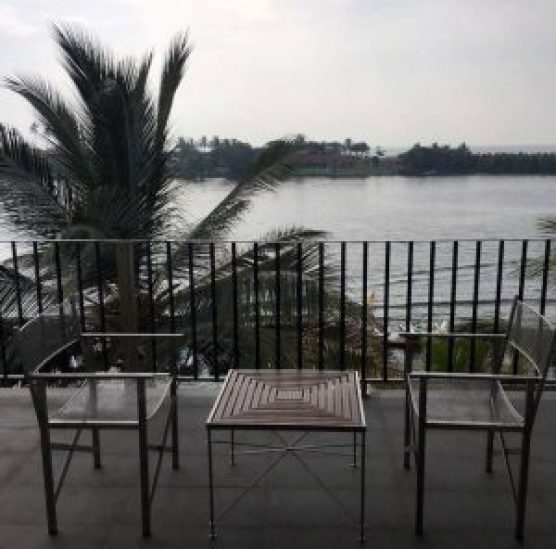
    Malu Banna has just opened their new penthouse suites with outstanding views of Bentota River and Malu Banna Watersports.

    You can relax on your private balcony, sip your refreshments and watch the world go by!

    The penthouses suites are extremely comfortable and clean with commanding views over the Bentota River and Malu Banna Watersports activities.

    There is always something to see and engage your imagination from your private balcony.

    The en suite washrooms are well appointed with modern fixtures.

    Bright and breezy with air conditioning if you need it – otherwise enjoy the airs coming straight of the ocean.

    Indulge in some personal down time or have en exhilarating ride with the on site watersports centre.

    Stroll along the riverside avenue, pass the time of day with friendly Sri Lanka people and be amazed by the open politeness and interest in you and your country.

    The Malu Banna Restaurant will prepare local and international dishes as you desire. The bar will keep you refreshed with local and international beverages.

    Malu Banna is Sri Lankan for fisherman – so you can be assured that all fish choices are freshly caught and delicious !


  • Good services

    We share our and our friends good experiences of good services in Sri Lanka


  • Good Taxi and Car Hire

    We gave had good experience and reports from these car and taxi hire services.

    Colombo / Pandadura

    Mr Lahiru Maduranga – telephone


  • Dive Sri Lanka

    Bathed in warm Indian Ocean currents, and with nearly 1600 kilometres/1000 miles of palm-fringed coastline, Sri Lanka is an amazing dive destination. This island nation has for millennia been a crossroads of historic shipping lanes, the Silk Road and other trade routes have shaped its unique culture. The landscape is as vibrant and varied above the water as it is below.

    The waters of Sri Lanka are home to an incredible range of marine creatures from massive blue whales all the way through to tiny nudibranch. Sri Lanka has an abundance of great sites to discover including great wreck dives which are scattered off the coast. Local divers are still discovering new wrecks as they explore the waters of this island nation. Many of the wrecks are covered in marine life, soft corals, macro critters and large aggregations of schooling fish. Above the surface, Sri Lanka also boasts wildlife reserves, which protect native species such as leopards, porcupines and anteaters. It is also famous for its unique foods and amazing teas, which should be sampled as part of any dive trip.

    Where you dive in Sri Lanka depends on when you plan to visit because the monsoon seasons vary from one end of the island to the other. October to May is the high season for diving the west and south-west coast, and May to October is the best time to dive the north-east coast. With incredible diving, friendly locals, amazing food and top side treasures, Sri Lanka truly offers it all.


    Great Sri Lankan Dive Sites

    Barracuda Reef – This is a great dive site waiting to be explored and it never disappoints. The reef provides shelter for a wide variety of aquatic creatures including lionfish, rays and nudibranch. Located off the coast of Mount Lavinia near Colombo, this is a popular dive site.
    Cargo Wreck – A 90 metre/295 feet wreck, which was a cargo carrier named Pecheur Breton, offers certified divers a massive wreck to explore. It sits at around 20 metres/65 feet at its shallowest point however the starboard side sits deeper than this. It is a haven for a wide variety of marine life, both big and small.
    Panadura Wreck – Sitting in around 12 metres/40 feet of water, this is a popular wreck for certified divers, which is also known as the Panadura Nilkete Wreck. The dive site is accessible by a short boat ride from Panadura. This is a great site to get a taste of the wreck diving available in Sri Lanka.
    Taprobane Reefs – Well offshore, some of the most pristine diving in Sri Lanka can be found on these reefs immortalized by Authur C. Clarke in his book The Reefs of Taprobane. Large patch reefs punctuated with massive coral domes are typical here. Marine life is abundant including large rays and schooling fish.
    Goda Gala Diyamba – This underwater rock formation, about 10 minutes by boat from the resort town of Unawatuna on the south side of Sri Lanka, lets divers explore reef systems loaded with large fish such as trevally and Napoleon wrasse. Discovering the dive site’s real charm requires shifting focus and trying to spot some of the many types of nudibranchs.
    HMS Hermes – Near Batticaloa, in the north-east, divers can descend on a rare World War II artifact: HMS Hermes. The ship was the world’s first purpose-built aircraft carrier. It sank off the coast after 1942 and is one of only a handful of carrier wrecks accessible to divers anywhere. Because it’s very deep, you will require PADI TecRec training to dive this wreck.
    British Sergeant – Sunk under fire along with HMS Hermes, but lying in shallower water, the British Sergeant is another WWII wreck that lies upside down and broken into two halves sitting at right angles to each other. Many features are still easily identifiable on this popular wreck.
    Boiler Wrecks – Lying in shallower waters at around 9 metres/30 feet, this site is made up of both the SS Brennus and SS Sir John Jackson which both met the same fate of running aground. Both wrecks are still largely intact with many of the propellers visible.
    Want to know more? Visit ScubaEarth® for further information on thousands of dive sites, marine species, destination essentials and more.

    Dive Sri Lanka Summary Information

    Visibility – Visibility ranges from around 10-25 metres/30-80 feet between high and low seasons.

    Water Temperature – Water temperatures are usually around 27° C/80° F for most of the year.

    Weather – Seasonal averages: 22°C/72°F in winter and 33°C/93°F in summer.West coast diving is best from around October to May, and the east coast is best from around May through to October.

    Featured Creatures – Blue and sperm whales, whale sharks. Green, loggerhead, hawksbill and leatherback turtles. Parrot fish, Napoleon wrasse and barracuda. Macro invertebrates, including nudibranchs.


    Sri Lanka Travel Info

    Note – Travel to any destination may be adversely affected by conditions including (but not limited) to security, entry and exit requirements, health conditions, local laws and culture, natural disasters and climate. Regardless of your destination, check your local travel advisory board or department for travel advice about that location when planning your trip and again shortly before you leave.

    Language – Sinhala and Tamil. English is widely spoken.

    Currency – Rupee (LKR). Credit cards are widely accepted.

    Major Airports – Colombo-Bandaranayake International Airport (CMB), Colombo, Sri Lanka.

    Electricity and Internet – 230V/50 HZ. Internet is available is many of the tourist areas.

    Topside Attractions – Sigiriya is an ancient palace in the Matale District featuring a massive rock column some 200 metres/660 feet tall. The Royal Palace of Kandy, which now accommodates the National Museum of Kandy. Yala National Park, which has the highest density of leopards on earth. The leopards share the park with herds of elephants. Alternatively, relax on one of the many beaches near many of the PADI Dive Shops or enjoy the nightlife in Colombo or other lively towns.